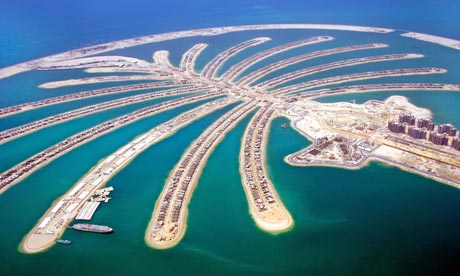
The vaunting towers of Dubai provide an irresistible metaphor for the hubris of globalised capitalism, and the newspapers have been falling over themselves to draw attention to the fact that this small, Gulf emirate is, quite literally, built on sand. For a green economist, however, it is the social and environmental consequences of this artificial paradise that raise the most pressing questions.
In the more ‘advanced’ economies of the West, the tasteful veil between government and corporation is still maintained – in Dubai this was not the case, and it is difficult when reading some of the press stories to distinguish between Dubai World – the venture capital development corporation responsible for the irresponsible building projects – and the state of Dubai. And surely Sheikh Mohammed bin Rashid al-Maktoum could have used the phrase ‘L’etat c’est moi’ with more aplomb than Louis XIV ever dared. Reading about his nefarious dealings makes one wonder whether George Clooney followed the Beckhams in the trek to buy luxury apartments on Dubai’s palmtree-shaped beach complex.
With energy no object it is possible to summon extraordinary buildings from sand and to make deserts bloom. The environmental consequences of this profligate use of the planet’s dwindling oil resources receive far too little attention. While public debate concentrates on China’s carbon dioxide emissions attention is distracted form the fact that the oil-producing states have the worst per capita record in this area. The other side of the coin is the human exploitation: the legions of South Asian immigrants who, like Irish navvies during our own 19th century building bonanza, were responsible for the heavy lifting for low pay that brought this crazed dream into existence.
Dubia is the apotheosis of an economy which is unsustainable in every sense: a grossly intensivised playground where the heedless and amoral playboys and playgirls, spawned by globalisation and a capitalist system that has broken all bounds of social control, enjoy pleasure without responsibility. Its gleaming untarnished towers are like the body of Dorian Gray; the abused workers and corrupted atmosphere are the the true picture, hidden away in the attic of our imaginations.*
 Dubai is the sort of development you end up with when you let money make all the decisions. The creation of an elite resort for the super-rich is a perfect illustration of the logic of this late and putrescent stage of capitalism. It tempts you to imagine your way into a near future and imagine children being shown pictures of the artificial archipelago to help them learn the lessons of ecology.
*Thanks to Mary Mellor for this metaphor, whose appeal has helpfully been broadened by the recent movie.